We have some exciting updates for October! Quantum Competitions v1.0 is officially live, bringing together Woo Lottery and Pick Number alongside a host of brand-new features. Demo website is here and documentation is here. For existing Pick Number clients we have deal – contact us for 80% discount coupon code (for first year).
WooCommerce Lottery and Pick Number are not abandoned and will still be maintained for security – plugins will have security issues patched and updated (just no new features).
We’ve also completely refreshed our website – be sure to take a look! As always, if you have any questions or need more information, feel free to submit a support ticket or drop us email.
By default, WooCommerce uses the same featured image everywhere: on shop and category pages, and as the first image on the product page. With this plugin, you can choose a separate image for the catalog, while the product page keeps its own images.
For example, you can use a branded cover or illustration in the catalog, and show screenshots or product photos once the customer opens the product.
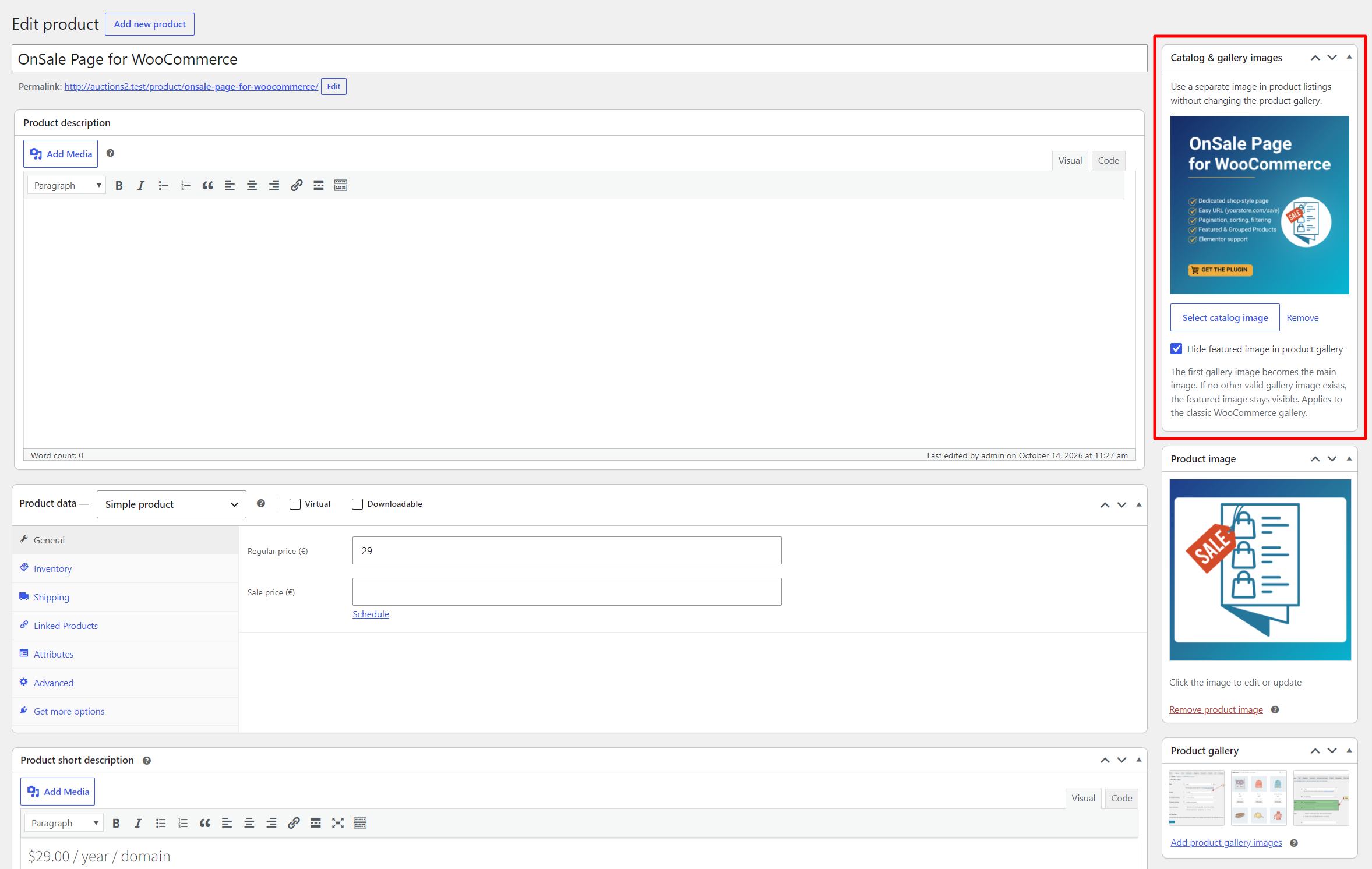
Catalog & gallery images box in the product editor
The plugin adds a Catalog & gallery images box to the product editor sidebar, with two options you can use separately or together:
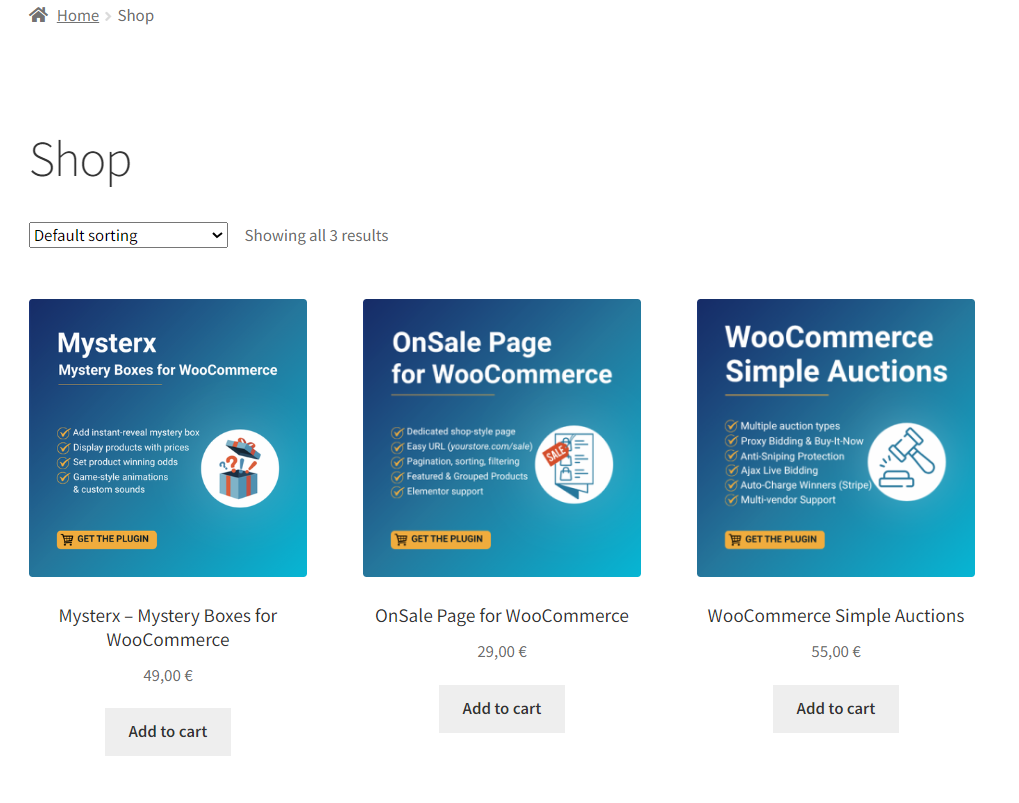
Catalog image: replaces the product image on shop pages, categories, product shortcodes, related products, and upsells.
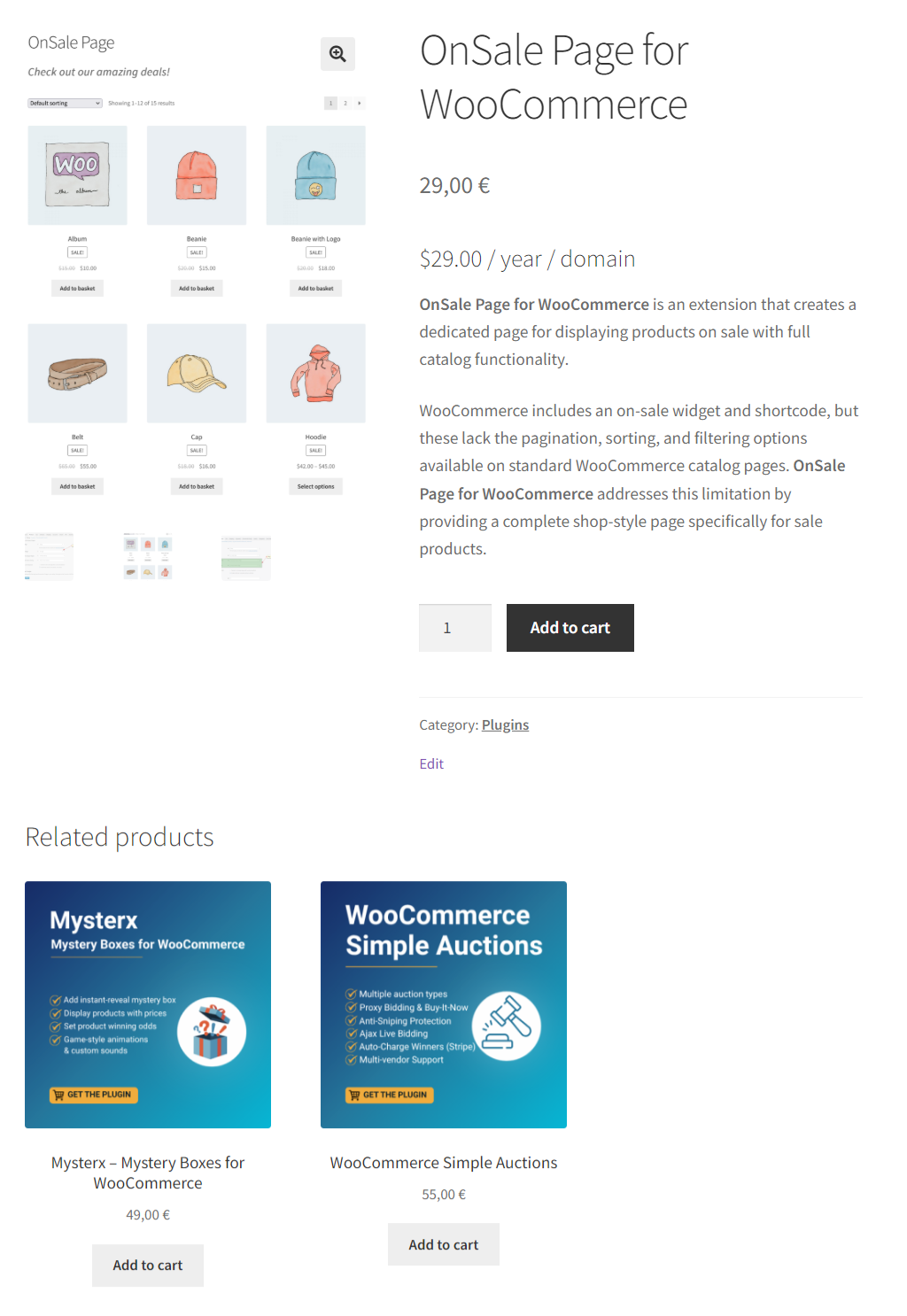
Hide featured image in product gallery: removes the featured image from the product page, so the gallery starts with the first gallery image. If there are no other gallery images, the featured image stays visible.
The featured image is still used everywhere else: in the cart, checkout, orders, emails, and when the product is shared on social media. This way, you can use a promotional or branded image in the catalog, while customers see a clean product image throughout the purchase. Your product images are never changed or deleted, and if you deactivate the plugin, everything returns to normal.
Catalog image on the shop page
Product page: gallery without the featured image, catalog images in related products
Cart page shows the featured image, not the catalog image
The plugin works with the classic WooCommerce product editor and standard WooCommerce themes. Block-based product collections and galleries are not supported yet.
Use Cases
Digital products (plugins, e-books, courses): a branded cover in the catalog, screenshots on the product page
A consistent catalog look: all products in the same style and format, with lifestyle or detail photos on the product page
Promotional images: catalog images with labels like “New” or “Sale” that don’t belong on the product page
No duplicate images: keep the featured image in the catalog and cart, but hide it from the product page gallery, without setting a catalog image
If you want different product images for your catalog and product pages, download Catalog Image for WooCommerce for free from WordPress.org.
Looking for other ways to improve your WooCommerce store? Check the complete list of our plugins that can help you bring your clients the best online shopping experience!
Let shoppers clear their cart with one click, or save multiple named carts and restore them anytime
We just released WPGenie Save & Clear Cart for WooCommerce, a new free plugin that gives your customers more control over their shopping cart.
With one click, shoppers can empty the entire cart instead of removing products one by one. They can also save their current selection as a named cart, start a new one, and come back to any saved cart later. Both registered customers and guests can save multiple carts, each with all product details, quantities, and attributes.
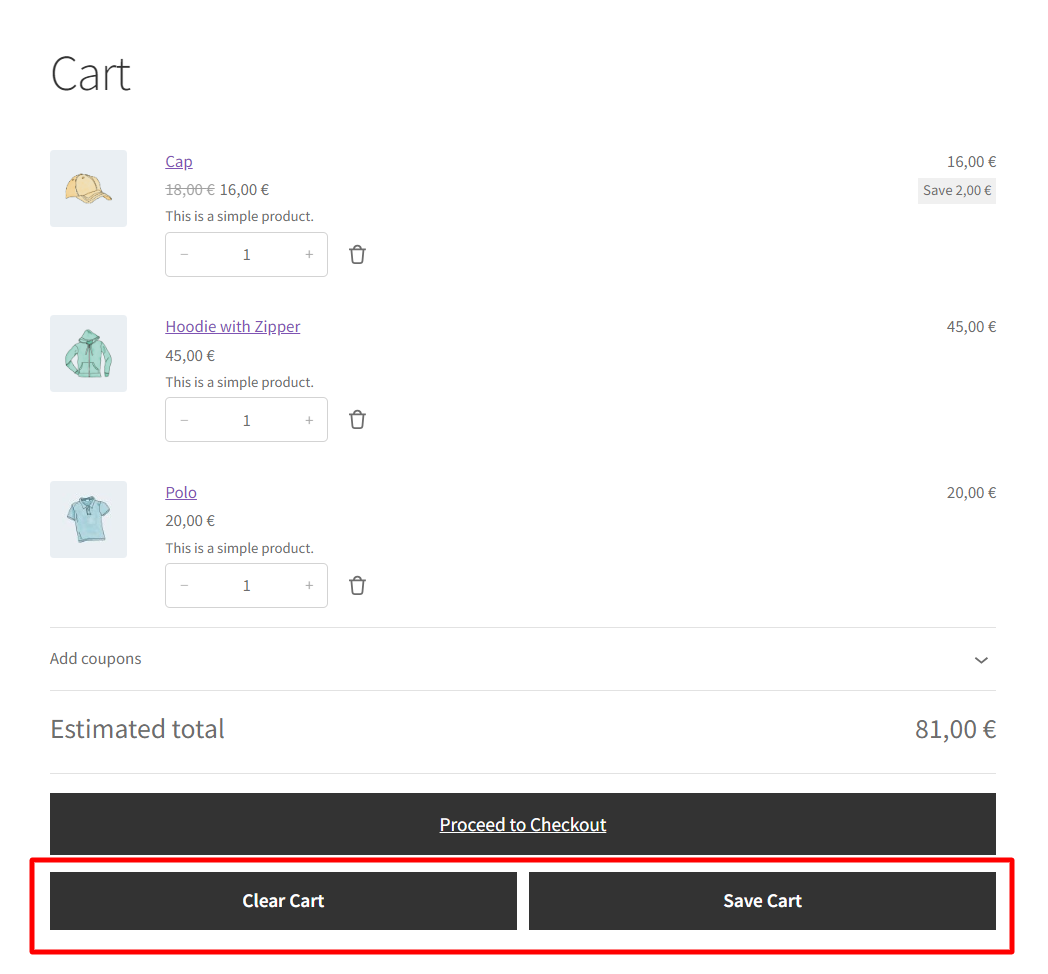
Clear Cart and Save Cart buttons on the WooCommerce cart page
Use Cases
Repeat orders, such as monthly supplies customers buy regularly
Separate shopping lists, for example office hardware and personal purchases
Planning ahead, like putting together a list of birthday gifts
Starting over without losing the current selection
How It Works
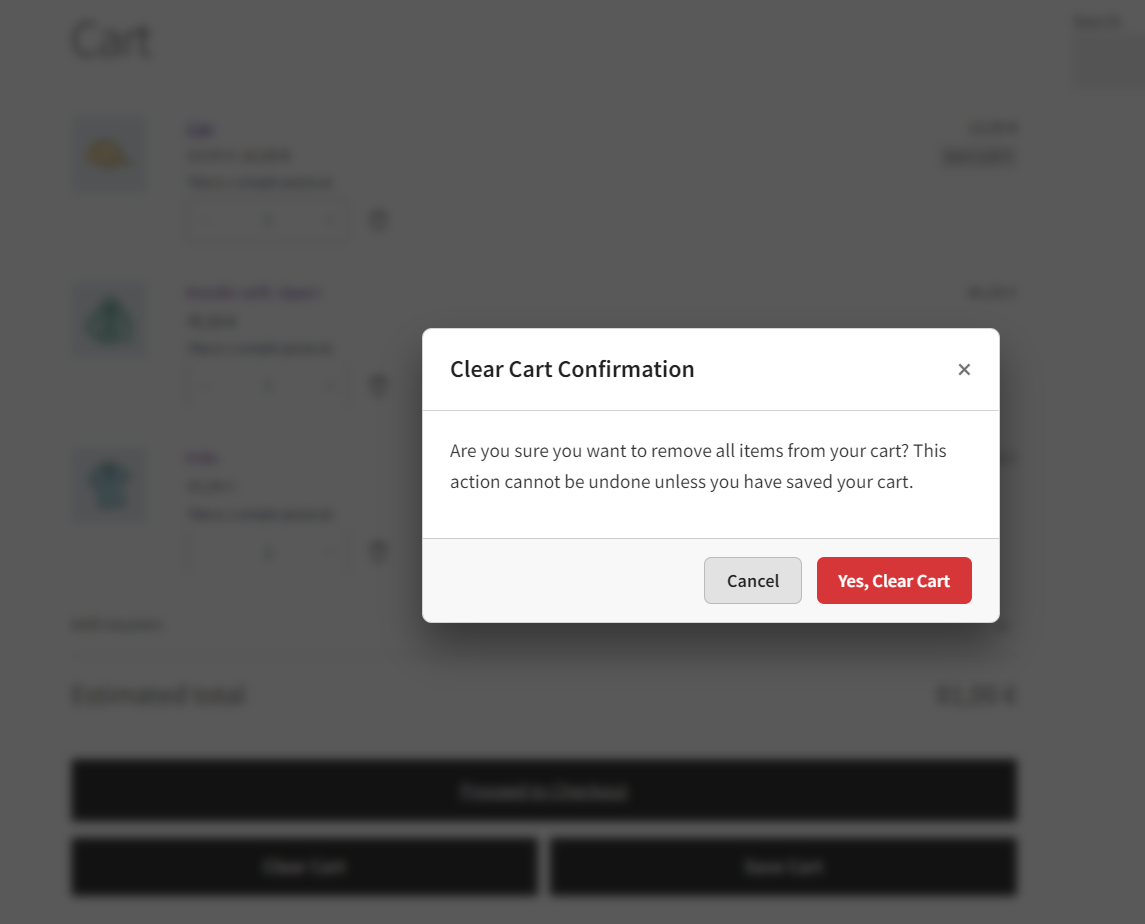
The plugin adds Clear Cart and Save Cart buttons to the WooCommerce cart page. Clear Cart shows a confirmation dialog before emptying the cart, so nothing gets removed by accident.
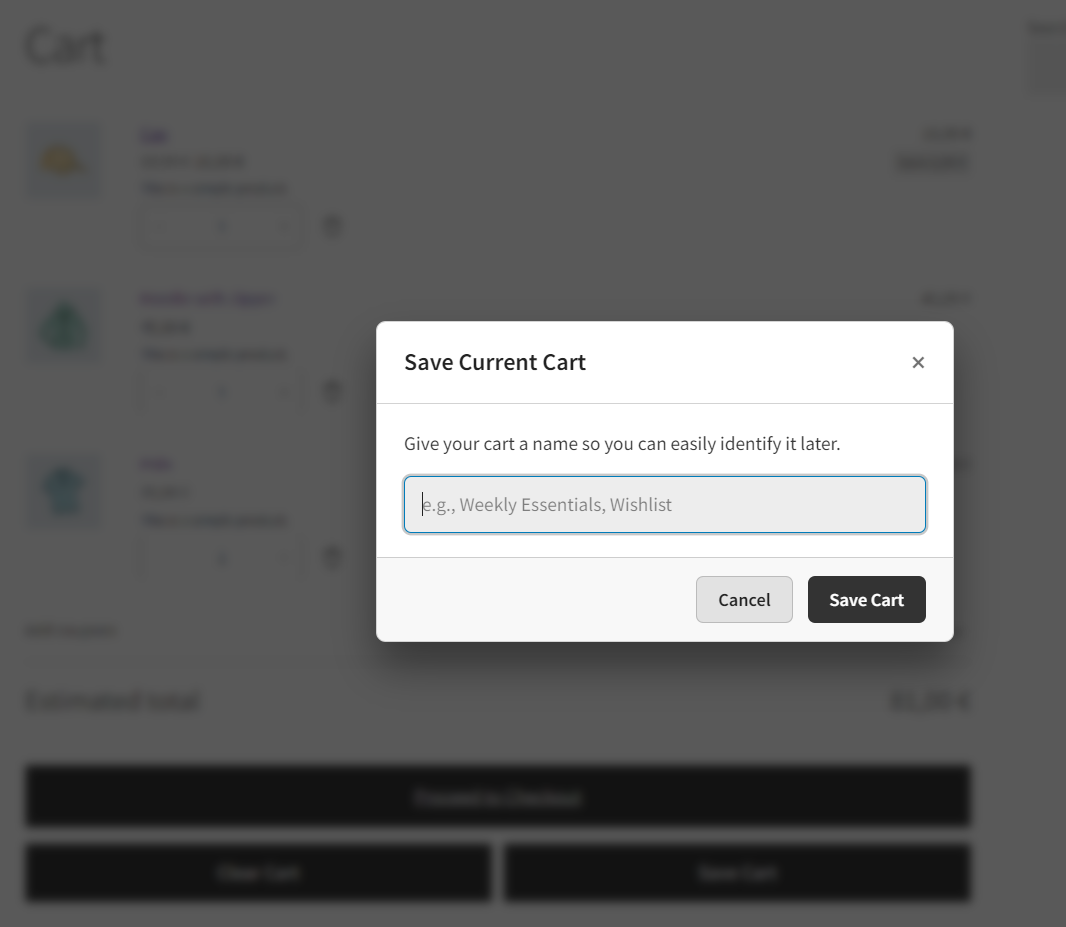
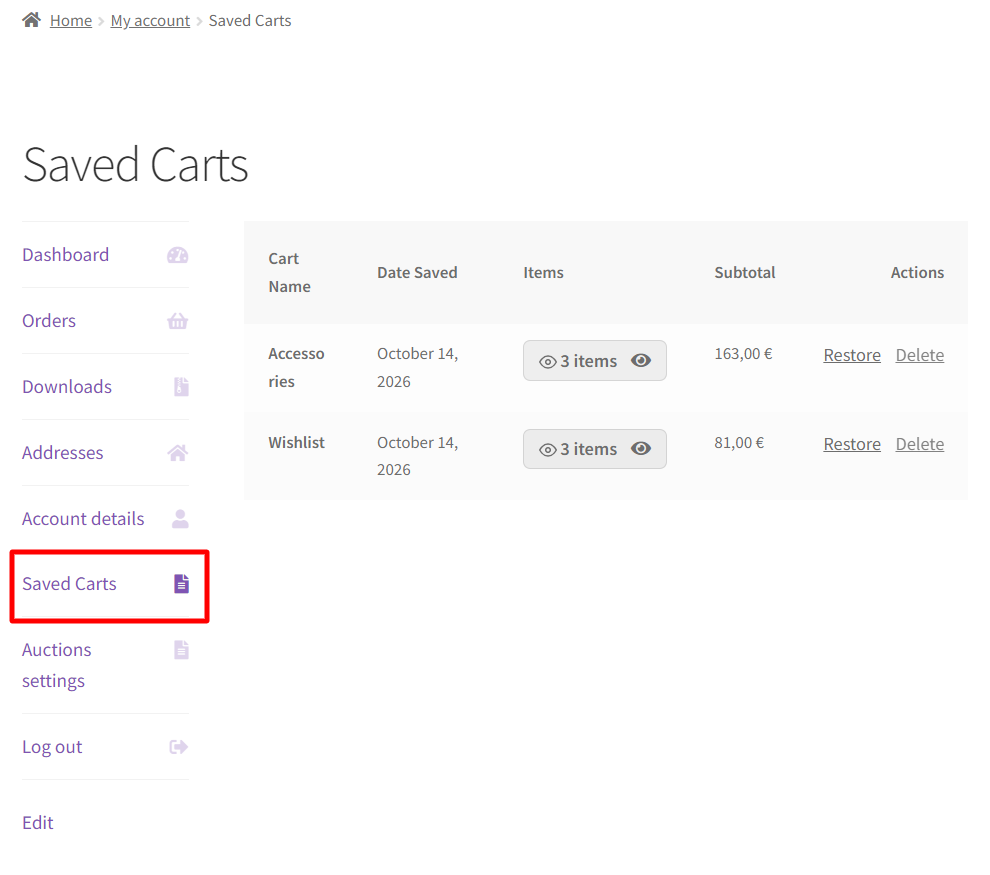
Save Cart lets customers name their current cart and store it. They can save as many carts as they need and manage each one separately. Saved carts are listed in a new Saved Carts section in My Account and below the cart table, where customers can review the items and restore any cart.
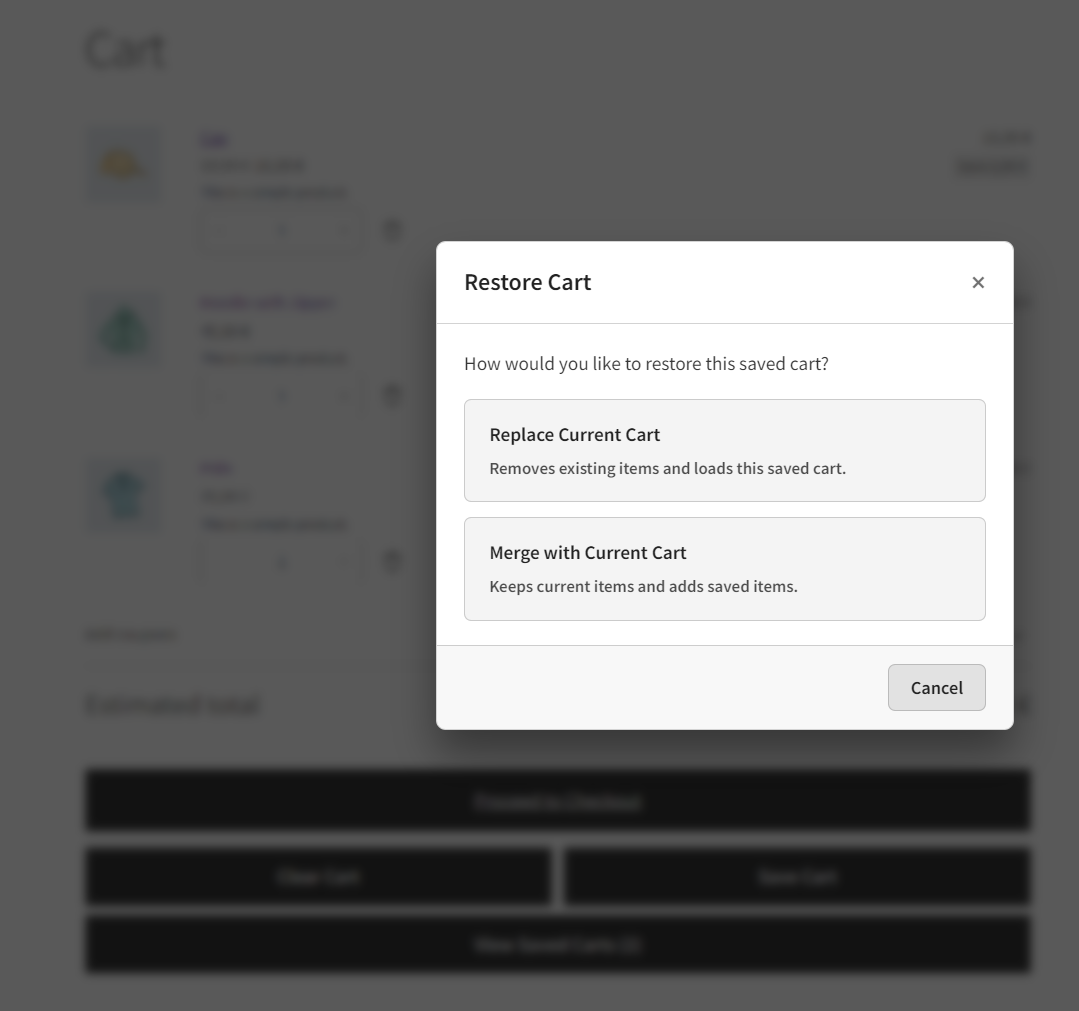
When restoring, the saved cart can replace the active cart or merge with it. You choose whether customers decide each time, or whether the store always replaces or always merges.
Guests can save carts during their browsing session. Once they log in or register, their saved carts move to their account automatically.
Naming a cart before saving it for later
Confirmation dialog before clearing the cart
Multiple saved carts in WooCommerce My Account
Choosing to replace or merge when restoring a saved cart
Customization
Button labels and colors (background, text, and border) are set in WooCommerce > Settings > Save & Clear Cart, without custom CSS. Two shortcodes let you place the buttons or the saved carts table on any page:
[wpgenie_save_clear_cart_buttons] displays the Clear Cart and Save Cart buttons
[wpgenie_saved_carts] displays the customer’s saved carts table
The plugin is lightweight and works with classic themes, block themes, the WooCommerce Cart block, and HPOS.
If the plugin helps your store, we’d really appreciate it if you left us a review 🙂
Looking for other ways to improve your WooCommerce store? Check the complete list of our plugins that can help you bring your clients the best online shopping experience!
You can buy WooCommerce Simple Auctions or its add-ons (Seated Auctions, Buy Bid Credits, and Role Base Bidding) in WPGenie’s Store.
Looking for other ways to improve your WooCommerce store? Check the complete list of our plugins that can help you bring your clients the best online shopping experience!
A great way to attract customers’ attention to your store is through a Dutch auction (or a decreasing-price sale), where buyers wait for the next price drop, knowing that waiting too long may mean losing the item they want.
In 2022 Samsung Electronics Australia ran an excellent Black Friday “Reverse Auction” campaign, which involved starting a product listed at full retail price and letting the price drop until all available items had been sold, or the price reached $1. The campaign generated significant attention: more than 51,600 people registered to participate, and Samsung reported a 270% year-on-year increase in Black Friday revenue.
The real potential of this type of campaign was not simply telling shoppers that “the price will drop.” It was turning the price drop into an event. A limited number of products, automatically decreasing prices, countdowns, real-time updates, and the possibility of securing a premium product at a great price all created urgency and FOMO.
In e-commerce, this tactic is usually called a Dutch auction; Samsung’s “reverse auction” label was catchy, but technically a reverse auction is something quite different (more on that below).
In this article, we’ll explain what a Dutch auction is, how to set it up in your WooCommerce store, and how to use it to gamify the shopping experience, clear inventory faster and attract new customers.
Table of Contents
What is a Dutch auction (or a decreasing-price sale)
A decreasing-price sale is a marketing strategy that creates psychological urgency (FOMO) by lowering product price at set intervals.
What makes this tactic particularly effective is that the decreasing price itself becomes part of the urgency mechanism. Buyers face a classic trade-off: wait longer for a lower price, or buy now before someone else buys it.
In e-commerce, a decreasing-price sale is commonly called a Dutch auction. While they aren’t exactly the same thing, a traditional Dutch auction and a decreasing-price sale share the same core mechanic: the price systematically drops until a buyer makes a purchase.
Note: Although Samsung called its 2022 Black Friday campaign a “reverse auction,” it was actually a Dutch auction. A reverse auction is a format in which one buyer posts a project, service or product they need, and multiple sellers compete by lowering their prices to win the contract.
The top benefits of running a Dutch auction in WooCommerce
When used as a sales tactic, a Dutch auction serves as a powerful promotional strategy:
Benefit
How It Helps Your Store
Creates urgency
The price drops at regular intervals (e.g., every hour or every day), and buyers know that if they wait too long, someone else will buy the item first
Gamifies the shopping experience
It turns buying into a game: buyers must constantly balance their desire for a lower price against the risk of the product selling out entirely
Helps inventory clearance
Sellers use this tactic as a promotional event to clear out seasonal overstock, end-of-line electronics, or clearance items
Generates high engagement
Because prices change dynamically, buyers repeatedly return to your website to check the current price, significantly driving up traffic and brand engagement during the promotional period
How to add a Dutch auction to your WooCommerce store
You can add a Dutch auction to your WooCommerce store with Drop Prices for WooCommerce, a free WooCommerce price drop plugin by WPGenie.
In this type of auction there is no traditional bidding process; instead, the price of the product is gradually reduced until a buyer accepts the currently displayed price.
Drop Prices for WooCommerce plugin integrates seamlessly with the standard WooCommerce Product Data metabox, enabling per-product configuration. This means you can choose any simple or variable product from your store, and offer it to your customers through a Dutch auction.
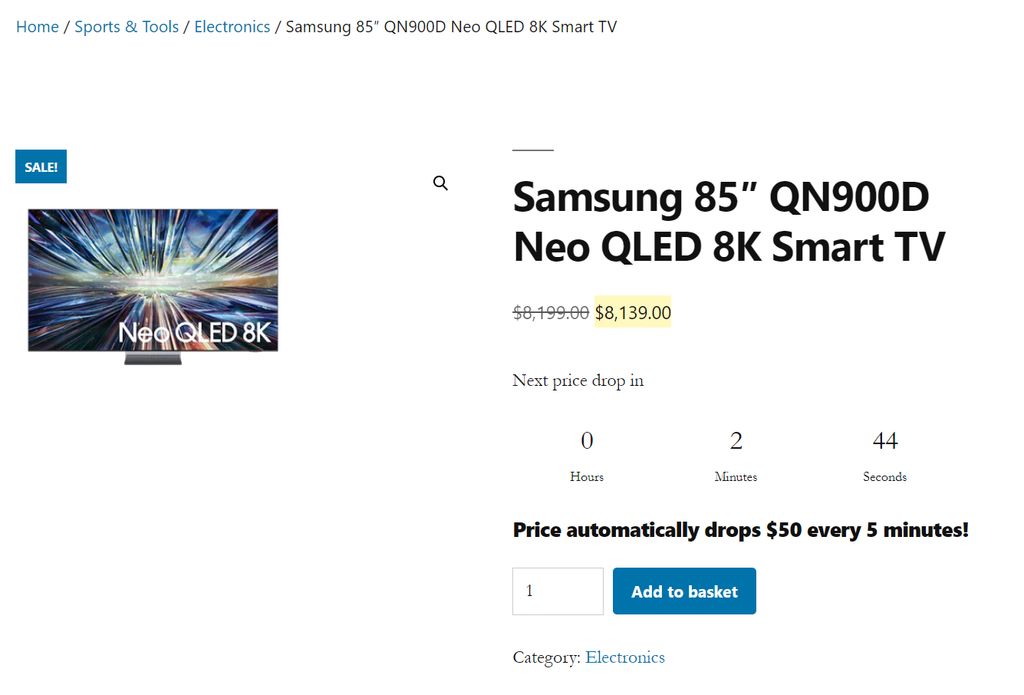
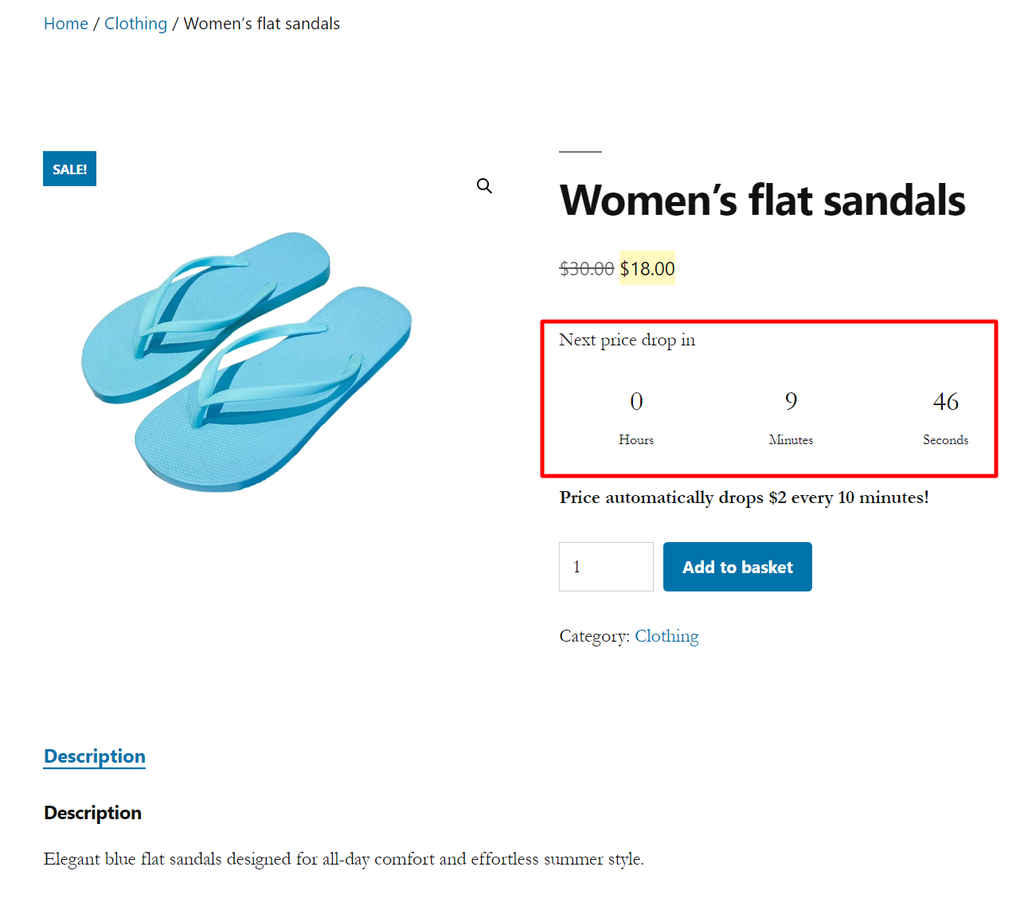
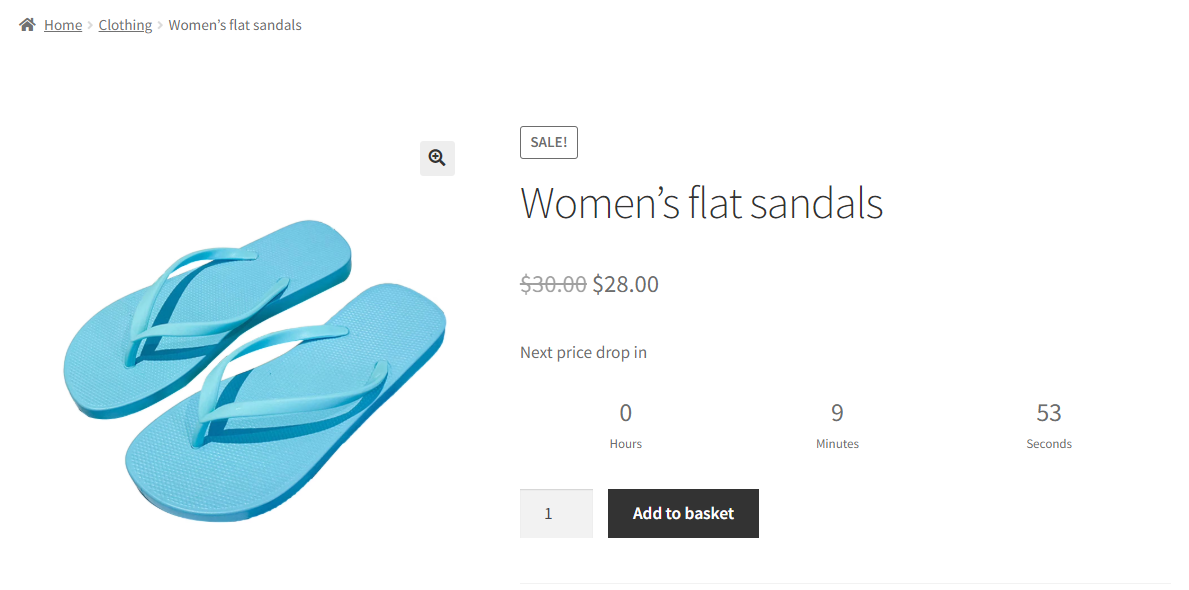
Once you’ve set up the price drop settings, the plugin will drop the product price automatically at the interval you set, with live countdown and an automatic price update on single product page and at checkout whenever a new price drop happens.
Single product page with a live price drop countdown. Offering premium products through a Dutch auction is a great marketing strategy.
Drop Prices for WooCommerce plugin
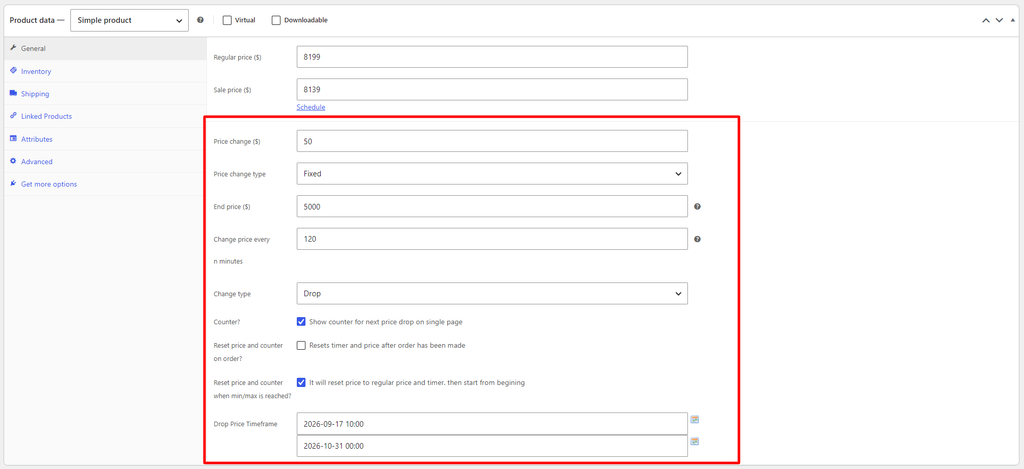
When editing a product, you’ll find several new fields under the General tab:
Price Change (Amount & Type): Define exactly how much the price drops using either a fixed amount or a percentage.
Intervals & Limits: Set a minimum price so you never sell below cost, and specify how often the price changes with the “Change price every n minutes” interval.
Automation & Schedule: Enable a live countdown timer on the product page and in the cart to create FOMO, and use the calendar picker to schedule the campaign’s exact timeframe.
Auto-Reset Options: Automatically reset the price and countdown timer and start from beginning after an order has been made, or after minimum price has been reached.
WooCommerce Simple Product data with price drop settings
A Dutch auction is a great way to clear inventory and give slow-moving products one more chance to sell.
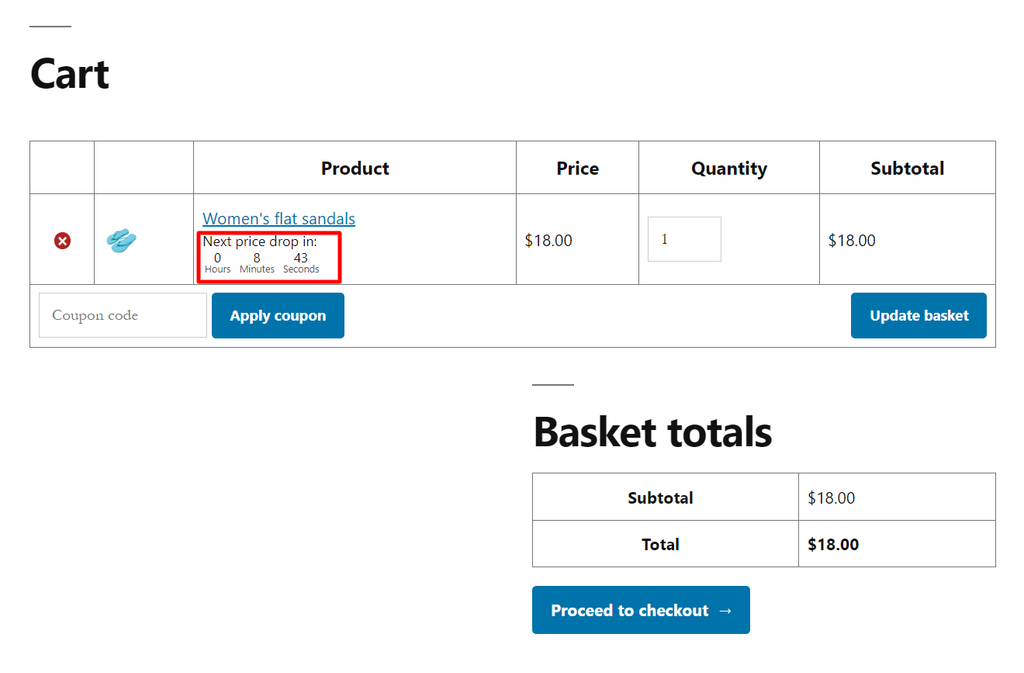
Cart page with a live countdown to the next price drop. When the price drops, the cart updates automatically.
With Drop Prices for WooCommerce, you can run a Dutch-style auction for any product from your store: whether it’s a slow-moving product you want to give one more chance, or a best-selling product you know will attract the most attention.
Here are the top use cases for implementing this strategy in a WooCommerce store:
When launching exclusive items (e.g., limited-edition merchandise, rare collectibles, event tickets, or artisan goods), setting up a decreasing price builds immense psychological pressure.
2. Inventory Clearance
Instead of running a standard static clearance sale (e.g., “Everything 30% Off”), a descending price mechanism clears non-moving inventory much faster while preserving higher margins.
3. Gamified Promotional Campaigns (Flash Sales)
Use a decreasing-price auction as a high-engagement marketing tactic during major shopping holidays (Black Friday, Cyber Monday, Anniversary Sales). If a high-value item price drops in price, it will definitely drive high user engagement, and keep visitors on your site longer
4. Price Discovery for Unique or Custom Products
When introducing a completely new product where you aren’t sure how much customers are willing to pay, setting a high starting price and letting it drop helps establish true market value.
Conclusion
Whether you want to clear slow-moving stock, find out what customers are willing to pay for a new product, or create buzz around your Black Friday campaign, a Dutch auction works for almost any product in your store.
With WPGenie’s Drop Prices for WooCommerce, you can set up a Dutch auction for any product in your store in just a few minutes.
Can I set up a Dutch auction in WooCommerce for free?
Yes. Drop Prices for WooCommerce is a free plugin available on WordPress.org. It lets you configure price drops for each product individually.
Does the plugin work with variable products?
Yes. Drop Prices for WooCommerce works with both simple and variable products.
How often should the price drop?
It depends on the length of your campaign. For a sale that runs a few days, hourly or daily drops work well. For a short, event-style sale, you can drop the price every few minutes to keep shoppers watching.
Will shoppers always see the current price?
Yes. The price updates live on the product page and in the cart, so shoppers always see the current price without refreshing the page.
What happens after someone buys the product?
If you’re selling a single item, the sale ends when it’s sold. If you have more units in stock, the price keeps dropping for the remaining units. Or you can enable auto-reset so the price and timer return to the starting price for the next buyer.
Do I need to set up anything on my server?
Yes. To make sure prices drop exactly on time, you need to set up a 1-minute cron job in your hosting control panel. If your host doesn’t support 1-minute intervals, you can use an external service like EasyCron. See our documentation for step-by-step instructions.
Is a decreasing-price sale a good idea for Black Friday?
Yes. Black Friday shoppers are already hunting for deals, and a falling price with a countdown adds urgency that a standard discount doesn’t. It works especially well for limited-stock or premium products.
Looking for other ways to improve your WooCommerce store? Check the complete list of our plugins that can help you bring your clients the best online shopping experience!
WooCommerce Group Buy and Deals is not available on CodeCanyon anymore, our old clients can contact us to create account and and get most recent update.
WooCommerce Group Buy and Deals is a powerful, affordable, and easy-to-set-up group buying solution for WordPress and WooCommerce.
This WooCommerce addon allows you to create a professional deals website similar to Groupon in minutes. Set up group buy deals where products become available only when enough buyers commit, with automatic deal tracking, progress bars, countdown timers, and full refund management for failed deals.
WPGenie released Drop Prices for WooCommerce version 2.1, and it has some great upgrades.
We’ve added an option to reset the price and countdown automatically once your set minimum or maximum price is reached, so product sale campaigns can start from the beginning.
Also, a live countdown now displays on the cart page and during checkout, and if the price changes before the order is finished, it recalculates dynamically.
Drop Prices for WooCommerce
Drop Prices for WooCommerce is a free plugin that automatically lowers, or raises, an individual product’s price at intervals the seller chooses. On a single product page, customers can see a countdown timer showing how much time is left until the next price change.
Inspired by Dutch auction style selling, this plugin adds gamification to shopping: customers must decide when a product’s cheap enough to buy. If they hesitate too long, however, they risk losing the item to another buyer. This creates high-converting, urgency-led flash sales or clearance campaigns for an individual product.
The plugin also offers the option to automatically raise a product’s price at set time intervals, which is a great option for pre-orders, product launches, and early-bird offers, where sellers want to reward customers who buy early.
We have released Pick Number Update on 14th Sep 2026 which brings important security fix along with new feature multi select for instant wins and instant winners table for easier management of instant wins. Please update it as soon as possible. Full change log is here.
If you open ticket we can do update for you for free.
We’ve released a new, free plugin on the WordPress.org repository: WPGenie Product Subscriptions for WooCommerce.
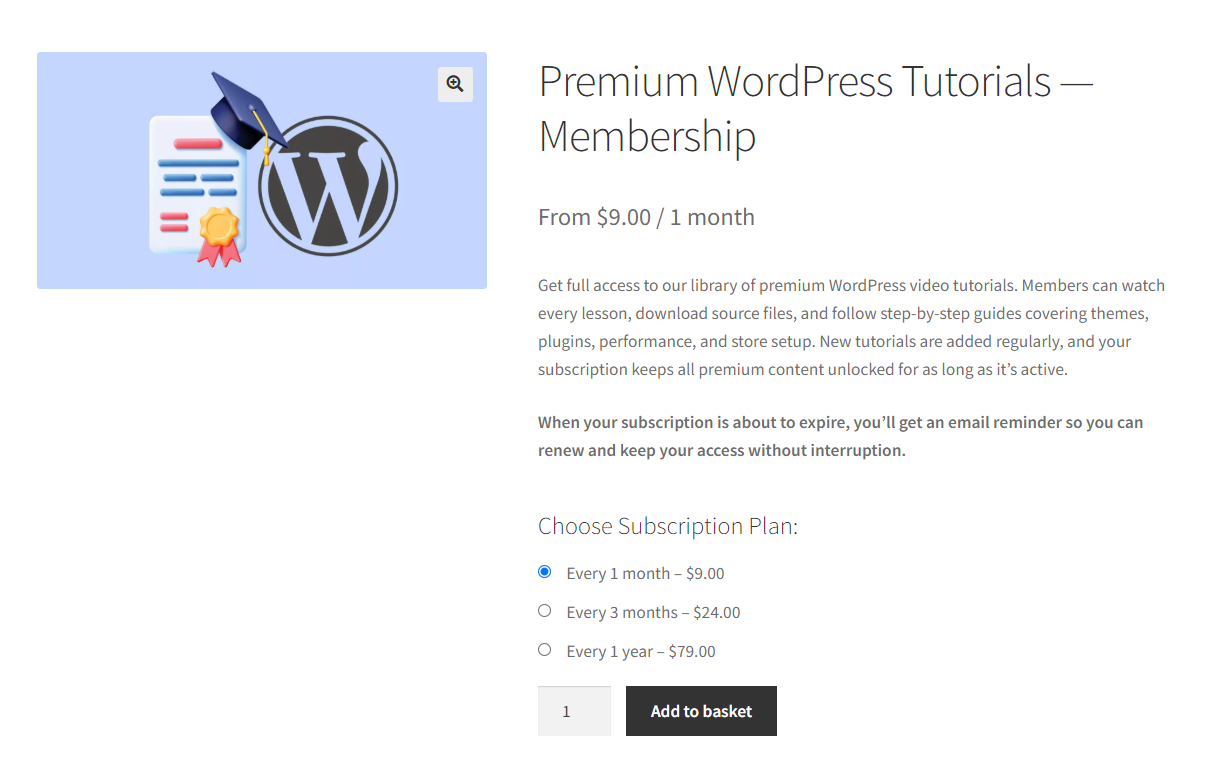
This lightweight plugin adds a subscription engine to WooCommerce products. With it, you can turn any simple product into a subscription with custom billing plans — each with its own interval, period (day, week, month, year), and price per plan.
On the single product page, you can display these plans as a dropdown or radio buttons.
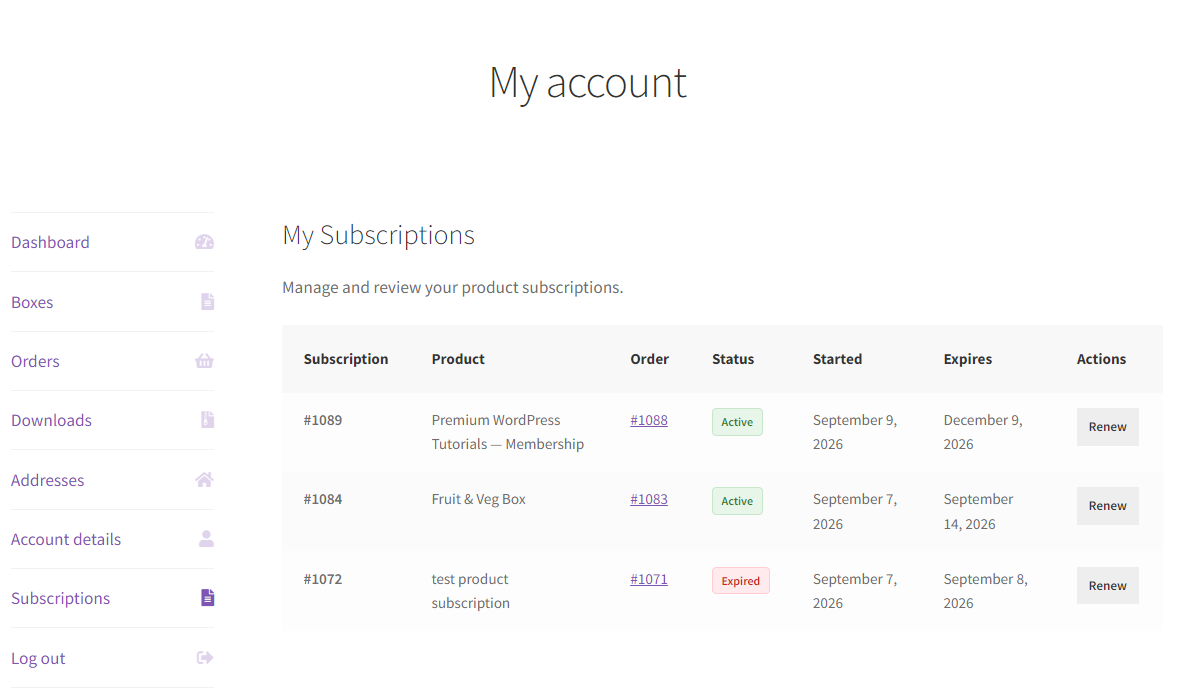
Customers can also view, manage, and manually renew their subscriptions from the “Subscriptions” page in My Account.
When a customer subscribes, the plugin creates a subscription record with start date, expiry date, status, customer details, and the original order, all manageable from the admin dashboard.
The important thing is that there’s no charging cards automatically: it sends customers automatic email reminders before their subscription ends, and renewals are made manually — either by the customer from their account, or from the admin dashboard. This means the plugin works with any payment gateway.
There’s also an option to restrict content to subscribers (with shortcode), and an option for admins to manually create a new subscription for a customer.
Use Cases
This plugin is ideal for small stores that want a simple way to sell subscriptions without a heavy billing system. It suits sellers who prefer manual renewals — like memberships, online courses, digital content, recurring services (maintenance, support, consulting), and box subscriptions. It’s also a good fit for stores that bill without automatic card charges.
New versions are out for several WPGenie plugins, each with security fixes and code cleanup
Behind the scenes over the summer, we rolled out updates across our plugin catalog. Every release came with security fixes and code cleanup, along with a few targeted improvements and bug fixes.
Here’s what changed.
Simple Auctions v3.0.10
Fixed an autocharge bug that occurred when the winner was different from the auction publisher
Relist handling improved: paid orders now stay intact and only unpaid orders fail on relist
Past orders are now saved on relist and displayed in the admin auction metabox
You can buy WooCommerce Simple Auctions, WooCommerce Lottery and WooCommerce Group Buy & Deals in WPGenie’s Store.
Looking for other ways to improve your WooCommerce store? Check the complete list of our plugins that can help you bring your clients the best online shopping experience!
Due to recent policy updates on CodeCanyon requiring all authors to be non-exclusive, we have adjusted our pricing on their platformand launched our own store
Due to recent policy updates on CodeCanyon requiring all authors to operate on a non-exclusive basis, we have updated the pricing of our plugins on the marketplace.
While the plugins remain exactly the same in functionality, updates, and quality, this change has allowed us to launch our own store and sell plugins directly at wpgenie.org.
All existing CodeCanyon customers will continue to receive full support and regular updates as usual, with no changes to their current licenses or access.
Same Plugins Now Available Directly from WPGenie
In addition to CodeCanyon, our plugins are now also available directly from our official store. Customers can now access the same plugins at a lower price compared to the marketplace, along with direct access to our support ticket system.
What This Means for Customers
The plugins available on WPGenie.org are the same plugins previously sold on CodeCanyon
Existing CodeCanyon customers will continue receiving updates and support
New customers can choose between CodeCanyon or direct purchase from WPGenie
Direct purchases include original lower pricing, with automatic access to our support ticket system
Instant-reveal mystery boxes are a highly effective, easy-to-implement gamification strategy that can boost engagement, clear inventory, and drive repeat purchases in your WooCommerce store
Mystery boxes have been extremely popular for the past few years, but as a concept they have a surprisingly long history. Some trace their origin to “grab bags” and “lucky dips” of Victorian-era fairs and markets, while others find their direct cultural ancestor in Japan’s fukubukuro (“lucky bag”) tradition. In any case, it is clear that they have proven to be more than just a passing trend.
What is the secret behind their popularity and longevity? For store owners, they are a powerful marketing engine, and the main reason is one of the perks of human psychology: we love the thrill of not knowing what we’ll get. When customers buy a mystery box, they aren’t just buying a product, they’re buying an experience.
Over their evolution, mystery boxes have come in different forms, from collector boxes of the mid-20th century to the modern mystery box boom that started around 2010, with the explosion of YouTube unboxing videos.
The newest trend blending gamification with retail is the instant-reveal mystery box, where you purchase a box and then immediately after watch a “virtual unboxing” animation (and, on some websites, trade or sell back unwanted digital or physical items).
In this article, we’ll explain what instant-reveal mystery boxes are and what their key benefits are for store owners. We’ll show you how to set up a mystery box in WooCommerce using the Mysterx – Mystery Boxes for WooCommerce plugin, and share a simple way to offer mystery boxes as free gifts to your customers.
What is an instant-reveal mystery box?
An instant-revealmystery box is a digital gamified shopping experience where you purchase a box of possible items through an e-commerce website or app at a set price, and you don’t know which one you’ll get until you “open” it digitally.
The instant-reveal mystery box evolved from two major trends over the last decade: video game loot boxes and physical mystery boxes. Instant-reveal mystery boxes essentially merge these two ideas. There’s the instant gratification and high-production-value animations of gaming software, but instead of winning virtual items like video game skins or armor, the customer gets a real product from the store’s catalog, drawn at random from the items in the box. Of course, stores selling digital goods can use the same mechanic to deliver virtual items instead.
Key Benefits for Stores
Here are the main benefits of offering instant-reveal mystery boxes in your store:
Benefit
How It Helps Your Store
Drives repeat purchases
Customers who enjoy the unboxing, or didn’t get the item they hoped for, often buy another box, turning one sale into several
Boosts customer engagement
Curiosity and anticipation drive repeat visits: customers browse the available items before buying and look forward to the unboxing animation
Creates strong value perception
A fairly priced box means customers always receive an item worth at least what they paid, and sometimes far more, which fuels word-of-mouth
Drives product discovery
Customers receive and actually try products they would never have clicked on, giving new or overlooked items real exposure
Clears slow-moving inventory
Gives slow sellers and end-of-season products a second chance by placing them in the box pool, moving inventory without resorting to discounts that erode your brand
Mysterx: An Instant-Reveal Mystery Box Plugin for WooCommerce
If you want to offer instant-reveal mystery boxes in your WooCommerce store, there’s an easy way to do it. You can use WPGenie’s Mysterx – Mystery Boxes for WooCommerce plugin, available in free and PRO versions.
Mysterx lets store owners easily create and sell instant-reveal mystery boxes, each containing a curated selection of products defined by the seller. Customers can see all items in the box before buying, but won’t know which one they’ll get until the on-screen unboxing animation reveals it.
You can use this plugin to:
Sell instant-reveal mystery boxes or blind boxes as standalone products
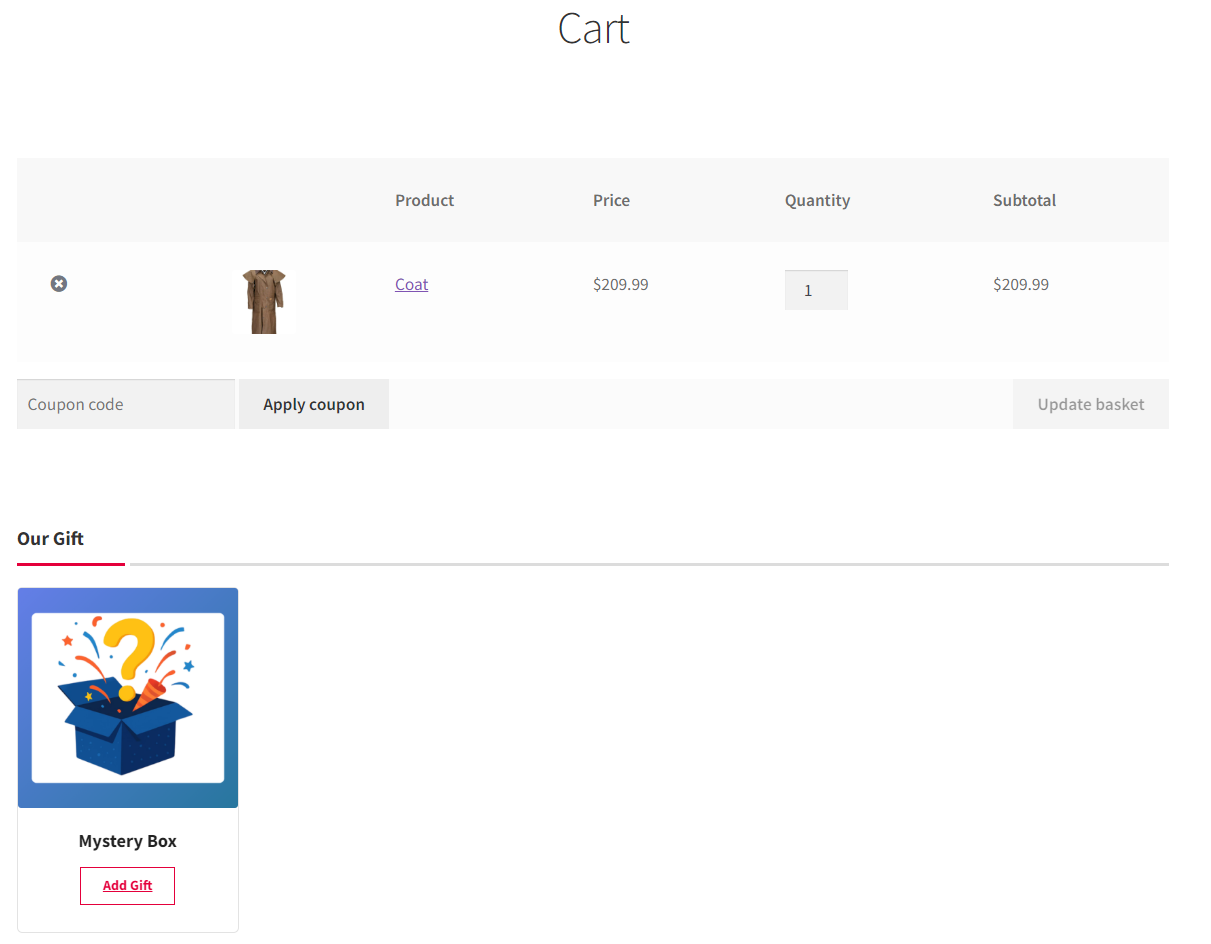
Offer a free mystery box as a thank-you for a purchase (you’ll need a “free gift” plugin)
How Mysterx Works
Mysterx – Mystery Boxes for WooCommerce adds a custom ‘Mystery Box’ product type to WooCommerce.
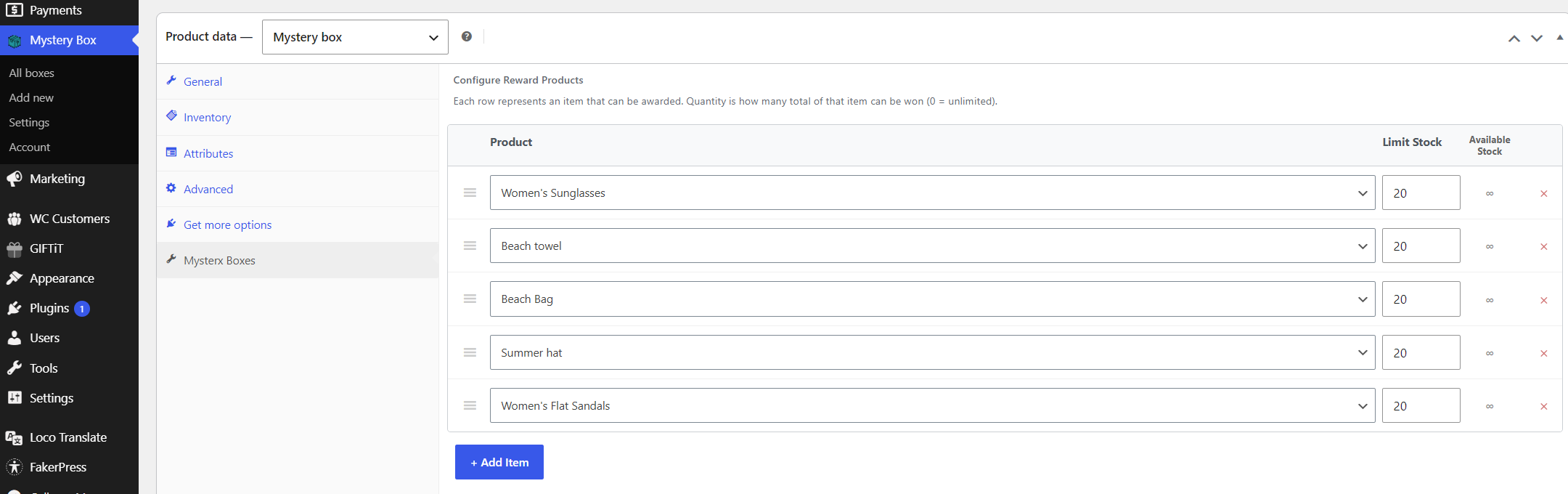
Store owners need to configure each box by defining the box price and then selecting the products they wish to include in the box. They can add as many products as they want to a single box and set stock levels for each item.
A new “Mystery Box” menu is added to the main WP Admin menu, and through it you can access Mysterx settings.
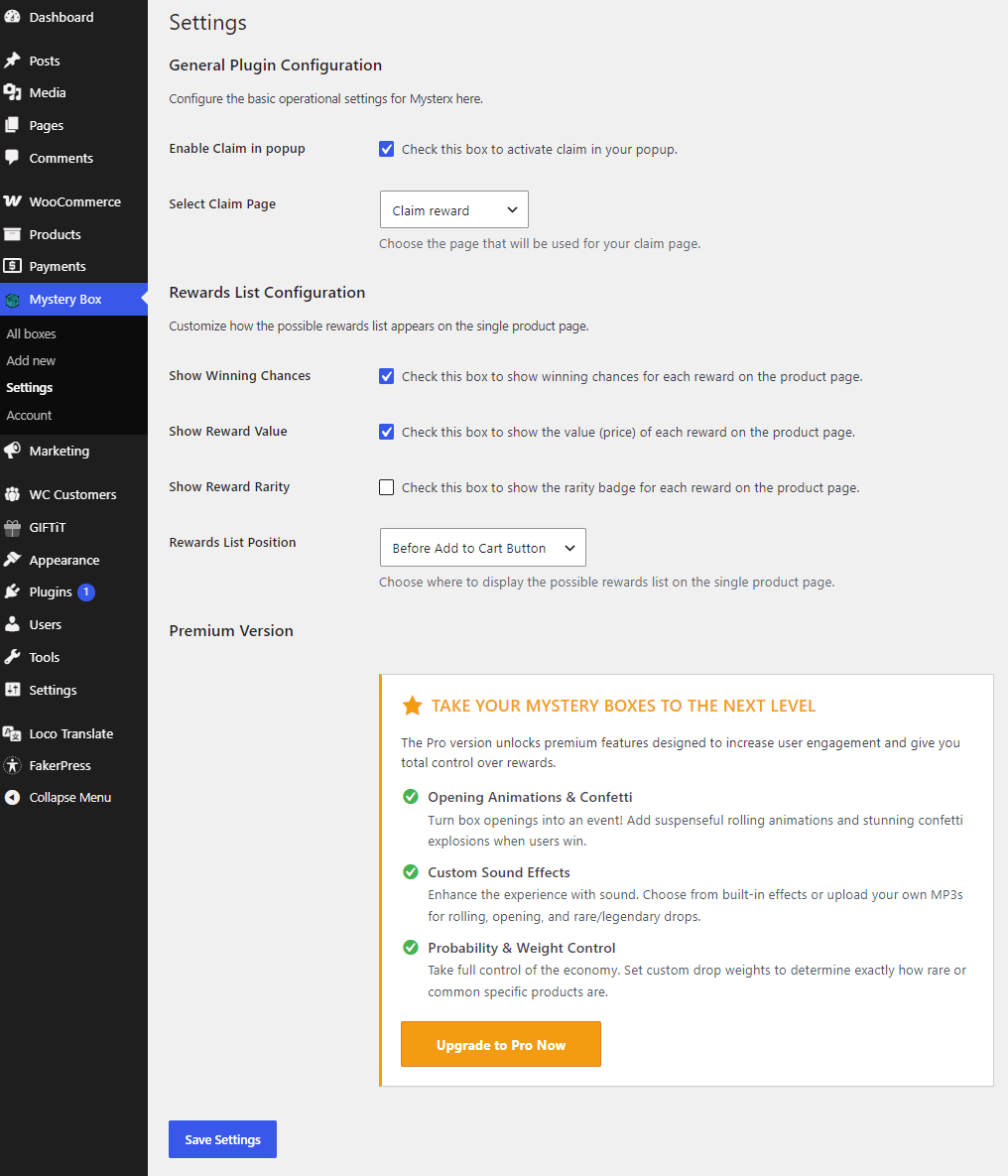
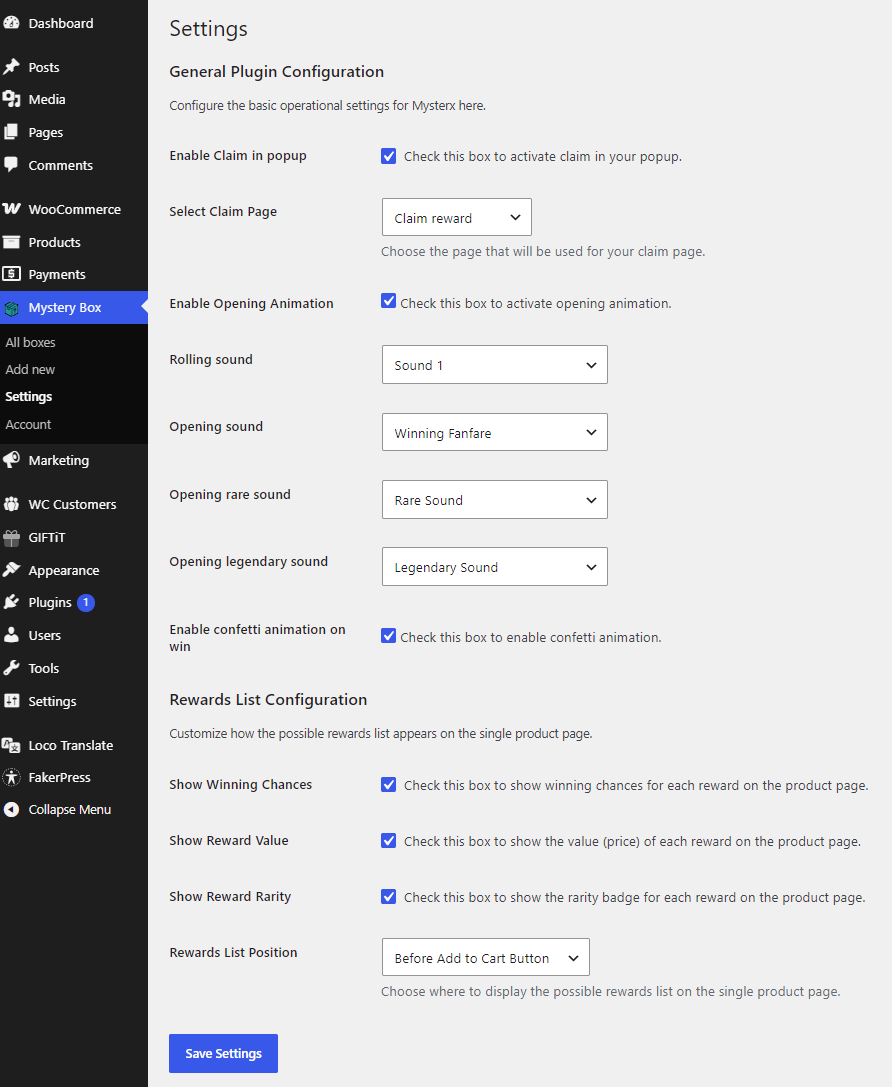
There is an option to activate claim popup and select a claim page. There are also options to customize how the list of possible items appears on the single product page. You can choose to display the value (price) of each item included in the box, as well as control the position of the items list: before or after the Add to Cart button, or before or after the product summary.
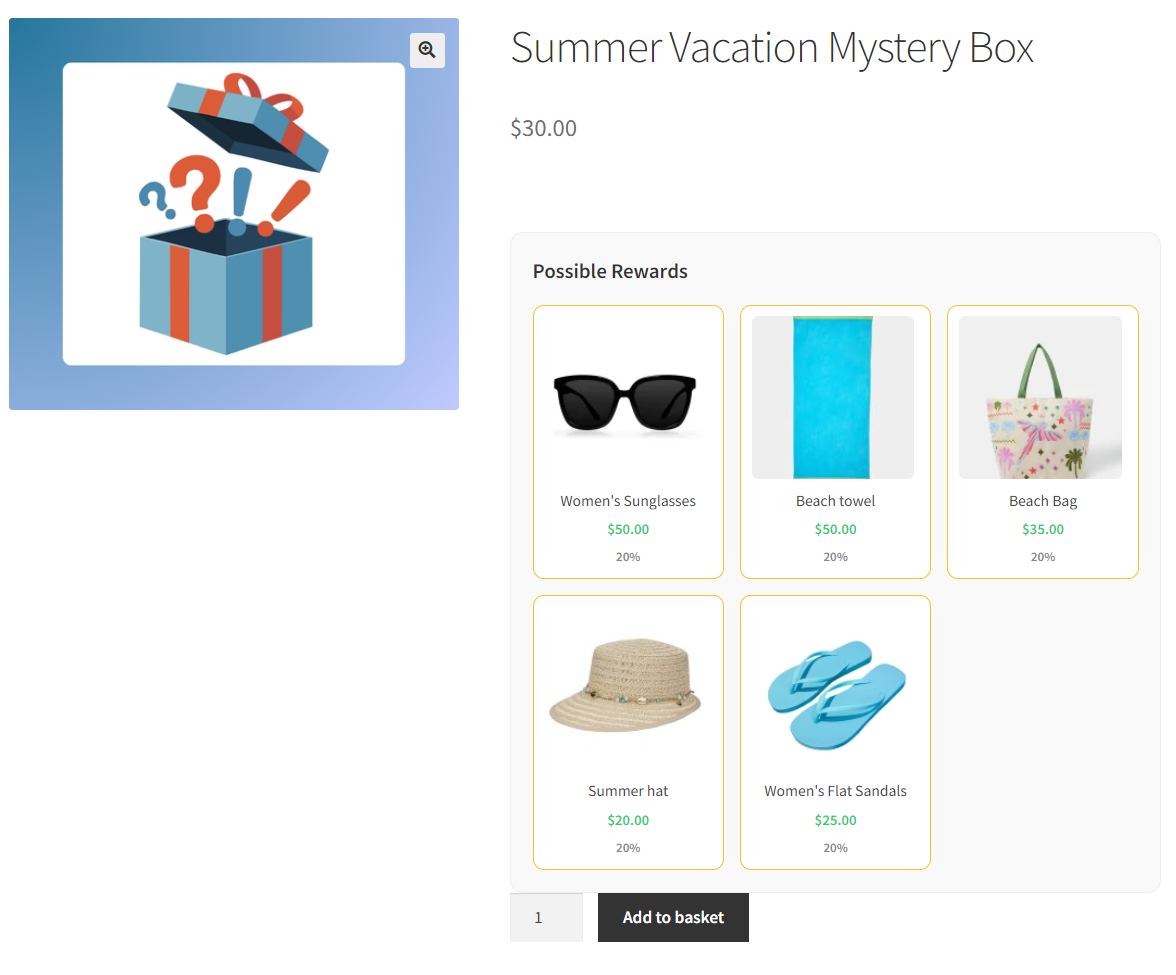
On the frontend, customers can see the list of possible items in the box, and there’s also an option to show them the value (price) of each product in the box.
Mysterx menu in WP admin and Product data – Mystery box where store owners need to configure the box
Mystery box – Settings(free version)
Frontend: Mystery box with list of possible items, prices and winning chances (equal for all items in free version)
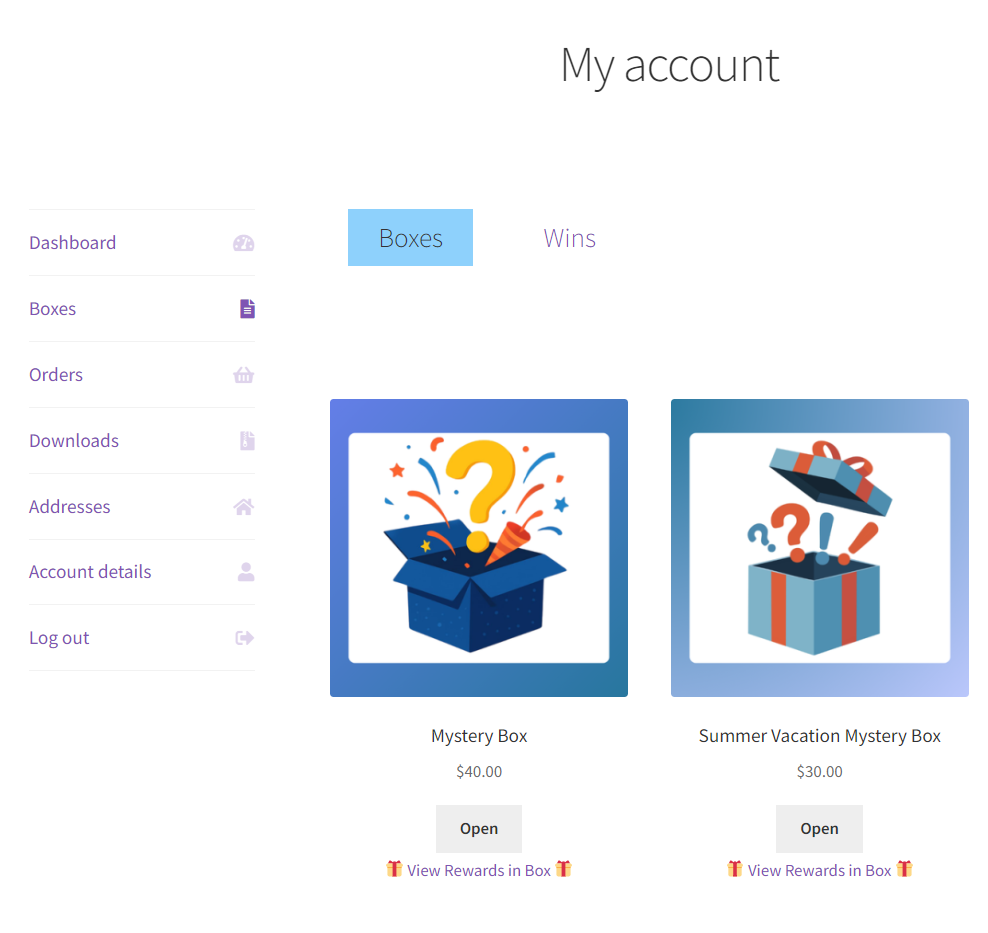
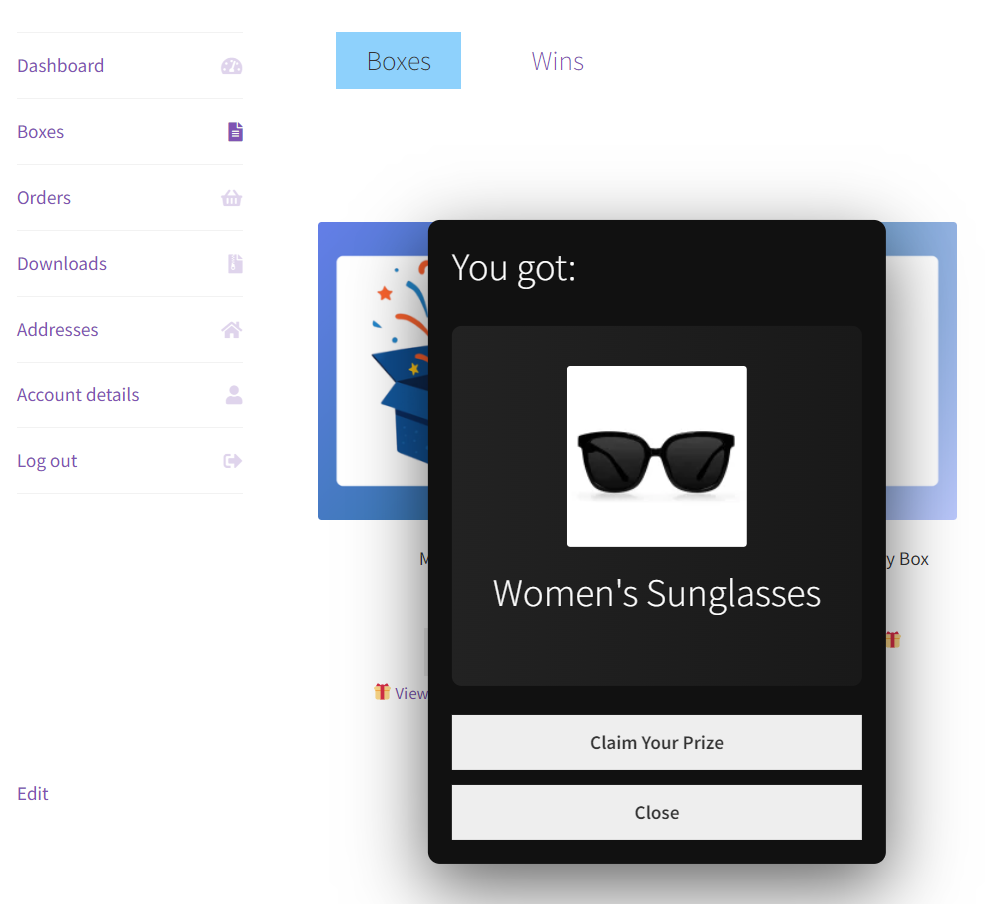
Customers buy an instant-reveal mystery box, and after the order is completed they get an “Open your Mystery Boxes” link on the order thank-you page, which takes them to My Account > Boxes. From there, customers can instantly open their box and find out which product they got.
For one mystery box purchase only one product can be received. This product is chosen at random from the items in the box. Mysterx handles the random selection automatically and deducts the correct item from stores actual inventory.
In My Account > Boxes, customers can also track unopened boxes and view all the products they’ve received.
Frontend: My Account – Boxes, before opening
Frontend: My Account – Boxes, digital unboxing
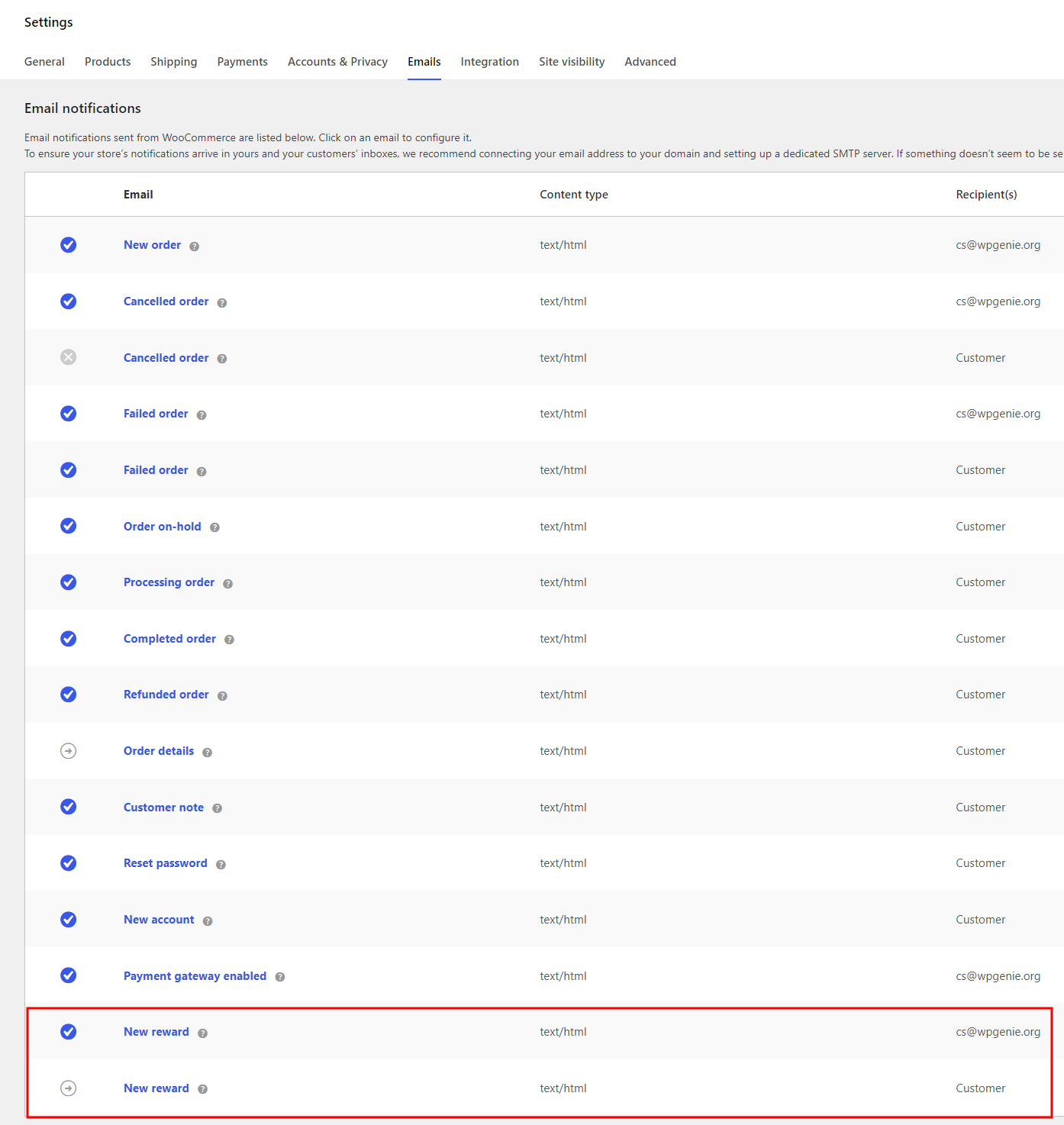
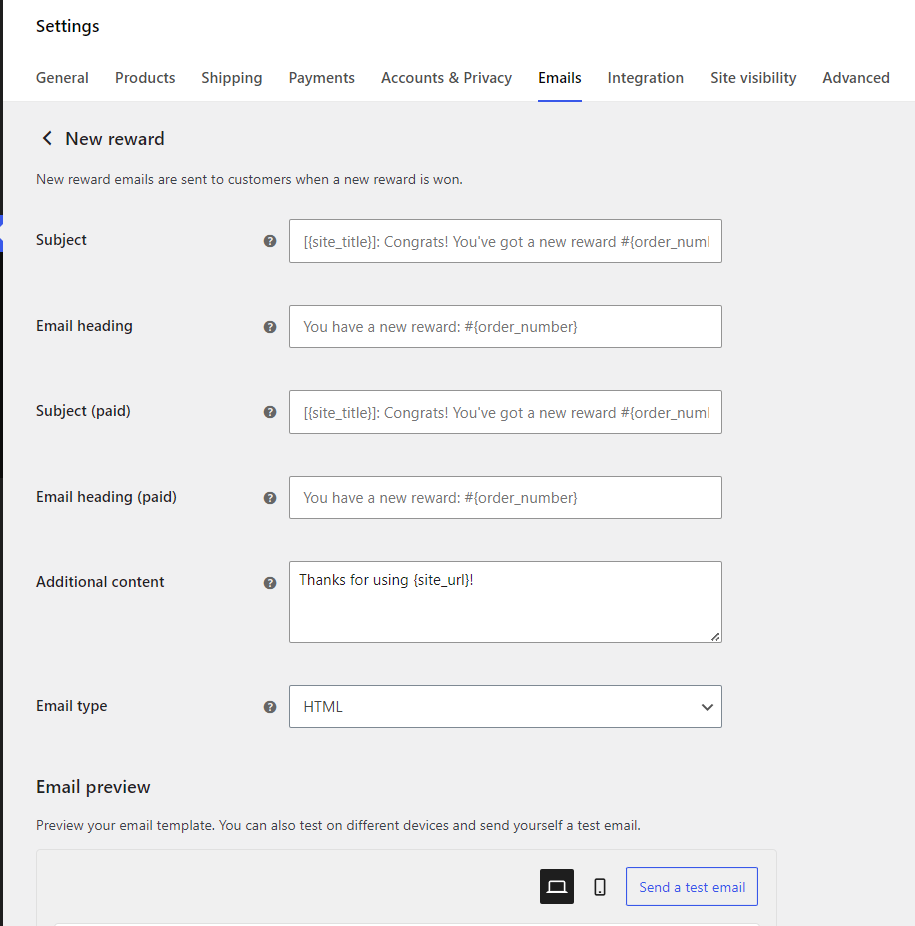
Mysterx also sends email notifications when a box is opened, one to the customer confirming what they got, and one to the store admin.
New reward email notification for website admin and for customer
Example of New reward email notification for customer
PRO version features
The PRO version offers additional features for user engagement and probability control:
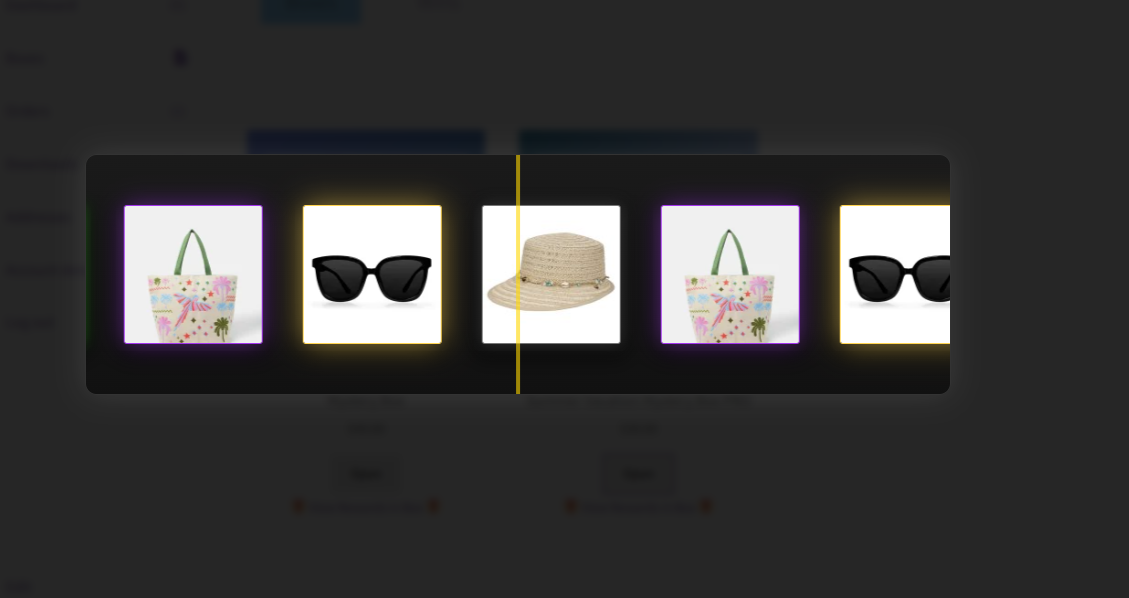
Opening Animation & Confetti On Win
Adds game-style reveal animation for the opening and fun confetti animation when the prize is revealed.
Custom Sound Effects
Chooses from built-in effects or upload your own audio for spinning, opening, rare item reveal, and legendary item reveal.
Probability & Weight Control
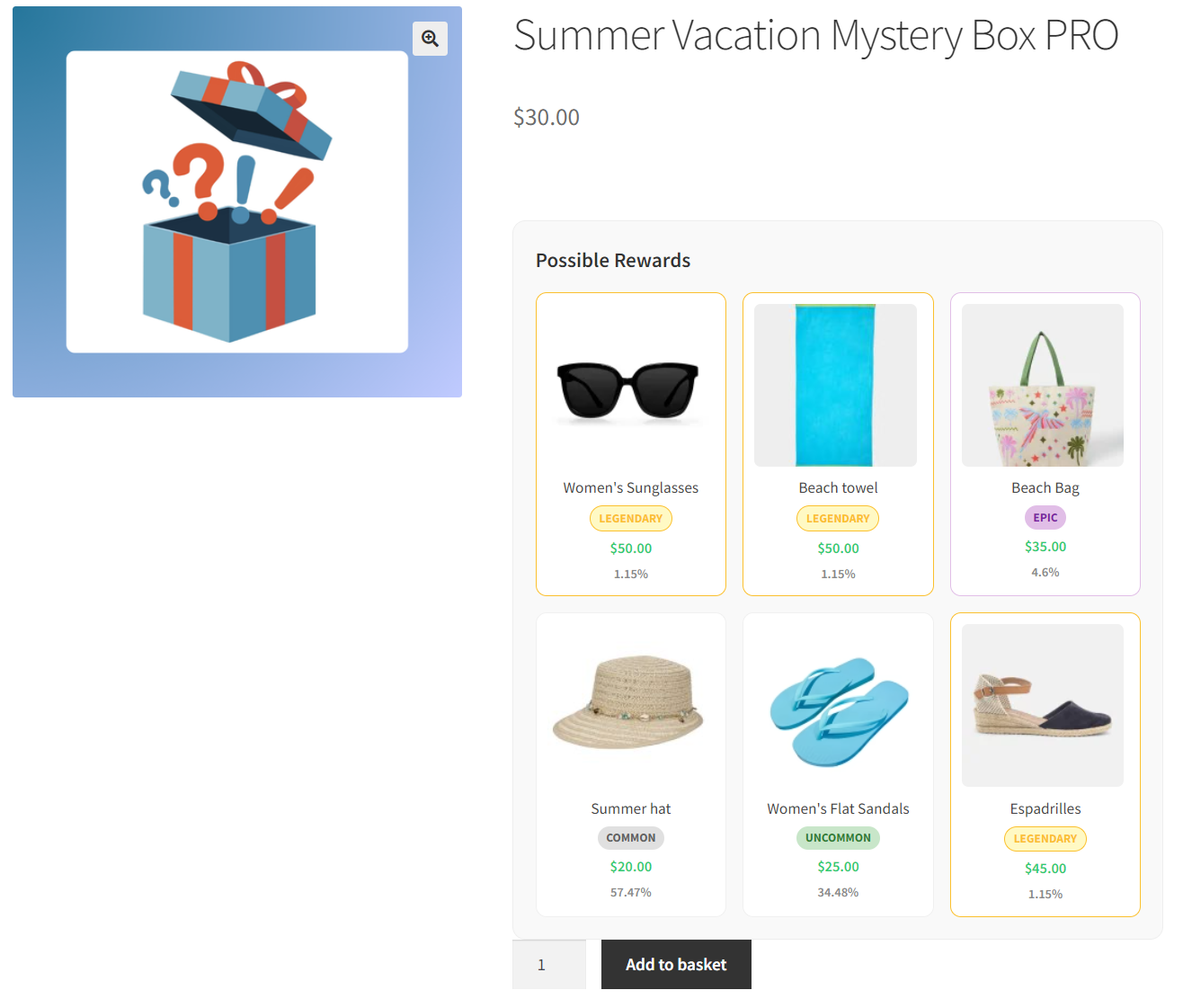
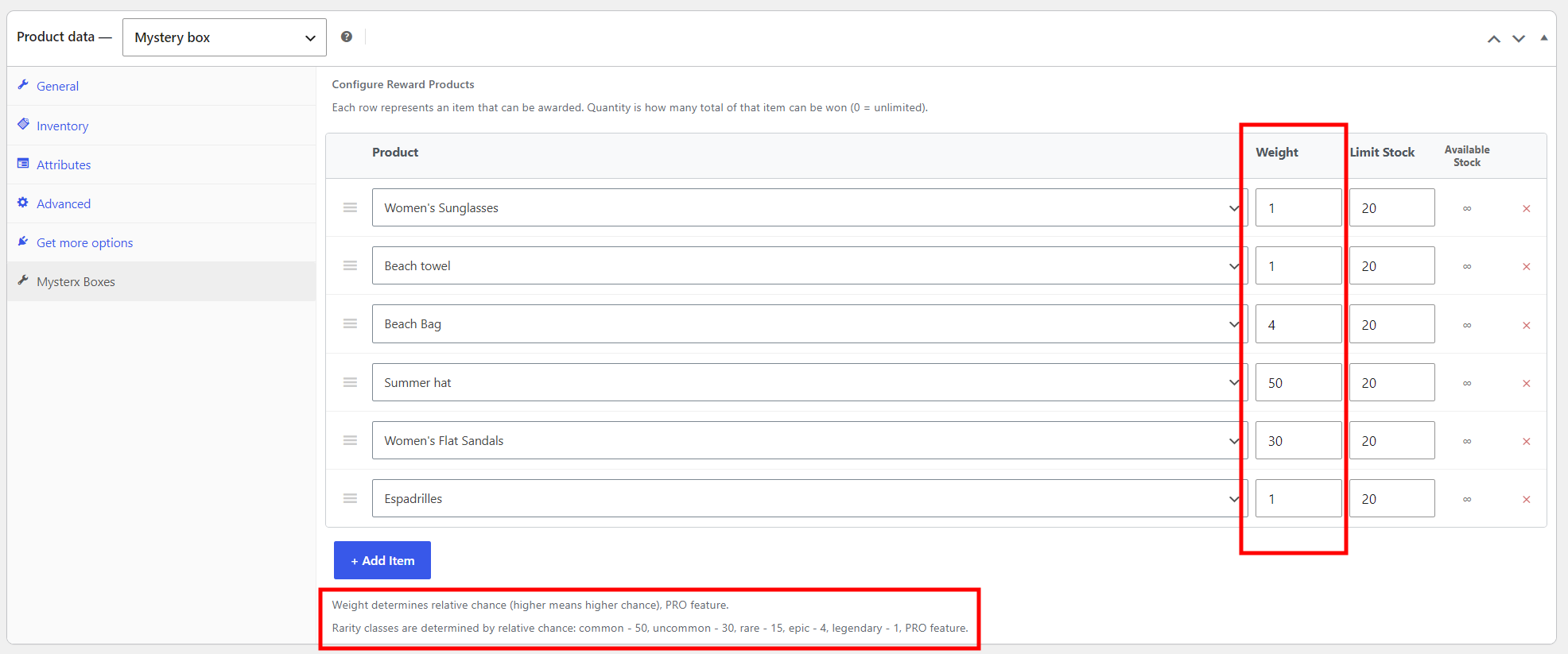
Sets custom item weights to control exactly how “rare” or “common” specific products are. Weight determines the relative chance of getting a product: higher weight means a customer has a bigger chance of getting it.
Premium Support
Direct access to the WPGenie ticket support system at wpgenie.org/support.
Frontend: Mystery box with list of possible items, with price, winning chances (determined by weight) and items rarity badge(PRO features)
Digital unboxing – opening animation(PRO feature)
Mysterx PRO: Product data with weight control (chance of winning the product)
Mysterx PRO – Settings
Instant-Reveal Mystery Box as a Gift to Customers
A free gift is one of the simplest ways to make a purchase feel special.
An instant-reveal mystery box makes an especially good gift because the gift itself is an experience: the customer gets to open a box and discover their reward, which adds a moment of genuine fun to the end of their purchase.
Create a mystery box as you normally would, then set it as a free gift that’s added to the customer’s order when they meet your conditions, for example, spending over a certain amount.
A few ideas for using this:
Reward orders above a spending threshold (great for raising order value)
Thank first-time customers with a small welcome box
Add a surprise box to orders during holiday campaigns
Conclusion
Instant-reveal mystery boxes combine anticipation, surprise, and instant digital unboxing into a single shopping experience. They’re a highly effective, low-effort strategy for WooCommerce stores to drive customer excitement and repeat interest.
With Mysterx – Mystery Boxes for WooCommerce plugin, you can add instant-reveal boxes to your store in a few minutes.
The free version of Mysterx is available on WordPress.org. For spinner animations, custom sounds, and item weight control, install the free version and then upgrade to PRO version.
An instant-reveal mystery box is a gamified shopping experience where you pay a set price for a box of possible items, and you don’t know which one you’ll get until you open it digitally. It combines video game loot boxes and physical mystery boxes into one format.
How do I add an instant-reveal mystery box to WooCommerce store?
The easiest way is with a dedicated plugin like Mysterx – Mystery Boxes for WooCommerce, which adds a “Mystery Box” product type to your store. You select the products that can be inside the box, set the price, and customers open the box on screen after purchase to see which item they got. Mysterx comes in a free and a PRO version.
Do customers know the value of products inside mystery box?
It depends on how the store owner sets up the box. Mysterx – Mystery boxes for WooCommerce lets store owners choose whether to display the value (price) of each possible item on the product page, so customers can see exactly what’s inside and what it’s worth before buying.
Are mystery box contents random, or does the store owner choose them?
The store owner chooses them. When setting up an instant-reveal mystery box with Mysterx, the store owner creates the list of products that appear inside the box.
How does the plugin pick the winning item?
When a customer opens a box, the plugin randomly selects one product from the items the store owner added. In the free version, every item has an equal chance of being picked. In the PRO version, store owners can assign weights to make some items rarer than others.
Can I set the winning probability for each product in a mystery box?
PRO adds weight control, which determines the relative chance of winning a product: a higher weight means a customer has a greater chance of getting it. This way, you can make a high-value item appear less often than everyday items and protect your margins. In the free version, every item in the box has an equal chance of being won.
Can I gift a mystery box to customers?
Yes, you can offer an instant-reveal mystery box as a free gift. It’s an excellent way to make a purchase feel special, reward loyal customers, and add a moment of fun to the checkout. To set it up, you’ll need the Mysterx plugin plus a free gift plugin for WooCommerce, such as Free Gift for WooCommerce.
Looking for other ways to improve your WooCommerce store? Check the complete list of our plugins that can help you bring your clients the best online shopping experience!